
BeamFeed Continues to Power Forward
Updated: Apr 15
First CUNY-based Company to Secure
A Finalist Spot at Rice Business Plan Competition
Updated 4/15/2026: BeamFeed won the $25,000 Amentum and WRX COMPANIES Rising Stars Prize for Space Technology & Commercial Aerospace at the Rice Business Plan Competition 2026.
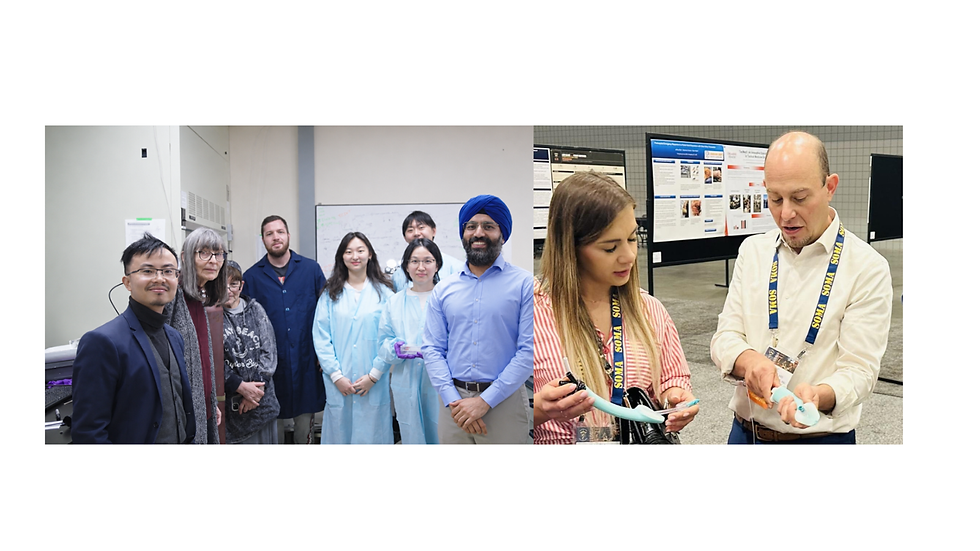
BeamFeed, a Manhattan-based startup creating a wireless power transfer system to charge and power distant devices like drones, is the first CUNY-based company to become a finalist at the prestigious Rice Business Plan Competition. As one of 42 finalists from 39 universities across four countries, BeamFeed, represented by co-founder Erina Vela and CUNY graduate student Sina Mohammadi, will head to Texas in April to participate in a series of competitions and workshops at Rice University. Only seven percent of applicants to the Rice graduate student competition are accepted.
The Rice competition is the latest in BeamFeed’s string of momentum-propelling milestones. At the start of 2025, BeamFeed secured a National Science Foundation (NSF) STTR grant of $305K. A few months later, it secured a NY State Innovation Matching Grant of $100K. BeamFeed also had its first company demo booth at the New York Innovation Summit last year, hosted with Empire State Development and Fuzehub.

Vela carries the dual role working towards her PhD in physics, with a specialty in photonics—the science of generating, detecting, and manipulating light—at the CUNY Graduate Center, as well as running BeamFeed. The new funding has enabled her to secure office space in midtown and purchase an optical table. “It’s not glamorous, but it is a luxury,” Vela said. “It’s incredible to walk into my own lab and focus on the work I was funded to do. It doesn’t feel like work because I’m so passionate about it.”
“Securing the grants has enabled us to expand our R&D, and it’s given us a new view of the trajectory of our technology and the impact we can make,” she added. “The world of wireless charging is truly untapped.”
Photonics uses light for functions typically handled by electronics—offering higher speeds and greater bandwidth for technologies like fiber optics, lasers, medical imaging, and solar panels. It’s at the core of BeamFeed’s long-distance wireless power technology, enabling an alternative energy solution without traditional wiring through light over air rather than fiber-optic cables.
Vela and her cofounders continue to work towards commercializing laser power beaming as the future shifts toward electrification. To continue testing their business model, last fall Vela was able to participate in another national I-Corps cohort, one dedicated to SBIR and STTR-funded companies.
“When you go through regional and national I-Corps as an academic student, with a very early-stage company, you’re exploring things in a theoretical way,” she said. “As a funded company, you have a very different perspective.”
Vela mentioned the value that CUNY’s Entrepreneur-in-Residence Arber Ruci brought as a leader of the SBIR/STTR cohort. “Every exercise was meaningful,” Vela added.
The experience of the most recent national SBIR/STTR I-Corps cohort enabled Vela to focus a sharper lens on pricing her solution over time. “I didn’t realize quite how much I would benefit from going through a cohort again, but it has really shaped how our technology will be delivered going forward,” she said.
“The competitiveness of the cohort itself provides a sense of humility,” Vela added. “I was lucky enough to secure the STTR grant, a milestone many innovators strive for to advance their technology. It was an inspiring opportunity to connect with and learn from other awardees.”
Vela also described the challenges of running a startup while pursuing a full-time PhD program. “Balancing it all is doable if you treat both roles separately instead of trying to blend them. I keep them separate, as I know I need to perform highly in each,” she said. “My objectives are different enough that I can compartmentalize; with my PhD I am optimized for my dissertation, ideally that also supports BeamFeed,” Vela added. “With my company, I am optimized for milestones like IP, regulatory approvals, and getting letters of support.”

That said, compartmentalizing only goes so far. “Sometimes one side of things helps the other,” she said. “There are times I am in the classroom, and I jot down notes in the margins that are relevant to my company. Or I learn a skill that is transferable into my PhD dissertation and publication work.”
“It’s hard and it requires discipline, but I’m driven by my vision of success,” added Vela. “That’s not necessarily commercial or financial success; whether this venture succeeds or not, I want to know that I did everything I could to drive an impactful solution. I’m not perfect, but I get up every day and try my best.”
“I’ve had great mentors,” Vela shared. “I was very independent when I was younger, and maybe a little stubborn. I’ve learned that it’s good to ask for help. Ariella [Trotsenko] and Arber have been instrumental in offering help and insights. They know my business well enough to ask me hard questions and help me to find answers.”


Comments