
Purafide: Harnessing Power to Purify Water
Ask questions. Lots of questions. It might change your life.

Born and raised in Queens, the son of immigrants from the former Yugoslavia, Selman Mujovic was always drawn to science and engineering. After attending New York City public schools, including the elite Bronx Science High School, he applied to the University of Michigan but admits he didn’t know much about it.
“They recruited from Bronx Science,” he said. “I went to my first Michigan football game, and I didn’t know who the quarterback was,” he says of the Big Ten university known for its collegiate athletics. “I participated in all of that life as much as I could—I was more outgoing than the typical engineering student.”
Mujovic was finding himself a bit bored by his coursework when he ran into his computer science professor on campus. “You’re then one who asks all the questions,” said his professor, who encouraged him to explore nuclear engineering. Contrary to Mujovic’s assumption, he learned it wasn’t just about building bombs.
“The electron is everywhere but nowhere at the same time,” said Mujovic enthusiastically. “I studied quantum mechanics with that professor. Then I met another professor working with plasma—energized gas. It’s what makes up lightning, stars, neon lights, and fluorescent lights. I thought it was cool that we can make plasma at a human scale; there is a wide range of applications, from getting seeds to grow more quickly to cleaning air and remediation.”
Mujovic worked with that professor to develop an early prototype for a plasma water reactor, or PWR—a device that would use that energy to purify water. “I wanted to get a better understanding of the fundamental science as well as its application. That professor suggested we participate in a national I-Corps session to get further funding for our research. Those were the early days—we were team number 554!”
“I always knew the plasma water reactor had commercial potential and the I-Corps mechanism was excellent in helping to identify it,” added Mujovic. “It was a great way to turn engineers into entrepreneurs, get people out of the lab and in front of ‘early-vangelists,’ and put problems before solutions. We did a ton of customer discovery, and I could see that water purification held enormous potential.”
Purafide’s technology offers a tool for water treatment managers to sustainably destroy pollutants without disposal costs and long-term liabilities, as the technology ultimately eliminates the toxins rather than creating a waste product.
Ultimately Mujovic and his professor parted ways, as Mujovic wanted to focus on commercial applications for the technology. Upon finishing his PhD, he stayed at Michigan for postdoc work, focusing on the molecule 14 dioxide. “It’s also known as hexavalent chromium—that’s the one the film Erin Brockovich made famous,” he said.
“All chemistry is rooted in the electron,” Mujovic added. “What makes plasma unique is you’ve freed the electron—it’s like an energy soup. When an electron in lightning hits a water molecule, it rips it apart. If the water is ultra-pure and you take out the energy, it recombines as water. If there’s a contaminant in it the lightning creates a chain reaction of purifying. If the plasma stays ‘on’ long enough, it doesn’t need to be retreated.”
Mujovic described some of the challenges of bringing such technology to market. “Water from different places—from drinking water, to sewage, to manufacturing runoff—presents different challenges,” he said. “It can take 20 years to successfully purify the water because of these variations. People send me waters that are difficult to treat, and I use the plasma to purify it. It enables us to do the build-test-learn cycle more quickly.”
The company has set its sights on PFAS, or per- and polyfluoroalkyl substances, a group of manufactured chemicals known for resisting water, oil, stains, and heat. They are known as “forever chemicals” because they do not break down easily in the environment and can build up in humans and animals, potentially causing serious health issues. There are hundreds of individual PFAS, each with their own recommended limits, but in the aggregate, the harm can accumulate more quickly. In 2019, for the first time, the federal government recognized PFAS as a collective environmental harm. There is now an effort underway to undo that approach.
“PFAS is hard to destroy, but if plasma keeps attacking it will ultimately break down,” he said. “Those chemicals are not regulated, so companies are trying to assess if it’s an issue but spend the least amount of money to do so. If they don’t have evidence of its presence, they aren’t compelled to clean it. The plasma treatment is effective because it ultimately destroys the toxic compounds. Destroying is better than filtration because it’s not building up in the environment. We help eliminate liability because we are destroying these compounds sustainably.”
Purafide’s innovative approach is captured by the company’s name. “We were trying to describe the spirit of our sustainability work,” he said. “We landed on Purafide since it was a combination of purified and bonafide, implying that we are legitimately sustainable by destroying pollution instead of just moving it from one place to another.”
“Early adopters of our technology see the vision of destroying PFAS—they are part of a new era of environmentalism,” added Mujovic. “But a lot of companies don’t care about cleaning up wastewater; they would rather just pay a fine.”

Mujovic participated in two regional I-Corps sessions since that first national one a decade ago. One of the biggest challenges he’s facing is continuing to scale and get pilot programs underway while convincing prospective customers to pay for his service. Prospective customers could include manufacturers, state environmental agencies, landfill management companies, and remediation specialists.
The NYC Innovation Hot Spot has sponsored Purafide to attend several conference, including for the recently passed 2025 New York State Innovation Summit. Purafide has also benefitted from the NYC Hot Spot mentoring services, entrepreneurial bootcamp training, and SBIR workshops. Purafide has received a NSF Phase I and II award for scaling and tailoring the destruction of emerging contaminants with their plasma water reactor. The company is also receiving Innovation Hot Spot tax benefits, and is part of the NYC portfolio of companies that received up to $3,000 each in prototyping funds.
“I am truly grateful to the Hot Spot team for all their support—it’s been a critical lifeline for our early-stage startup,” said Mujovic. “Additionally, the SBIR training helped fine-tune our proposals. Specifically, the NIH session provided a great checklist, got us working on the proposal early, and helped us focus on important parts of the proposals, such as the specific aims.” Following that training session, Purafide submitted a SBIR proposal to the National Institutes of Health.
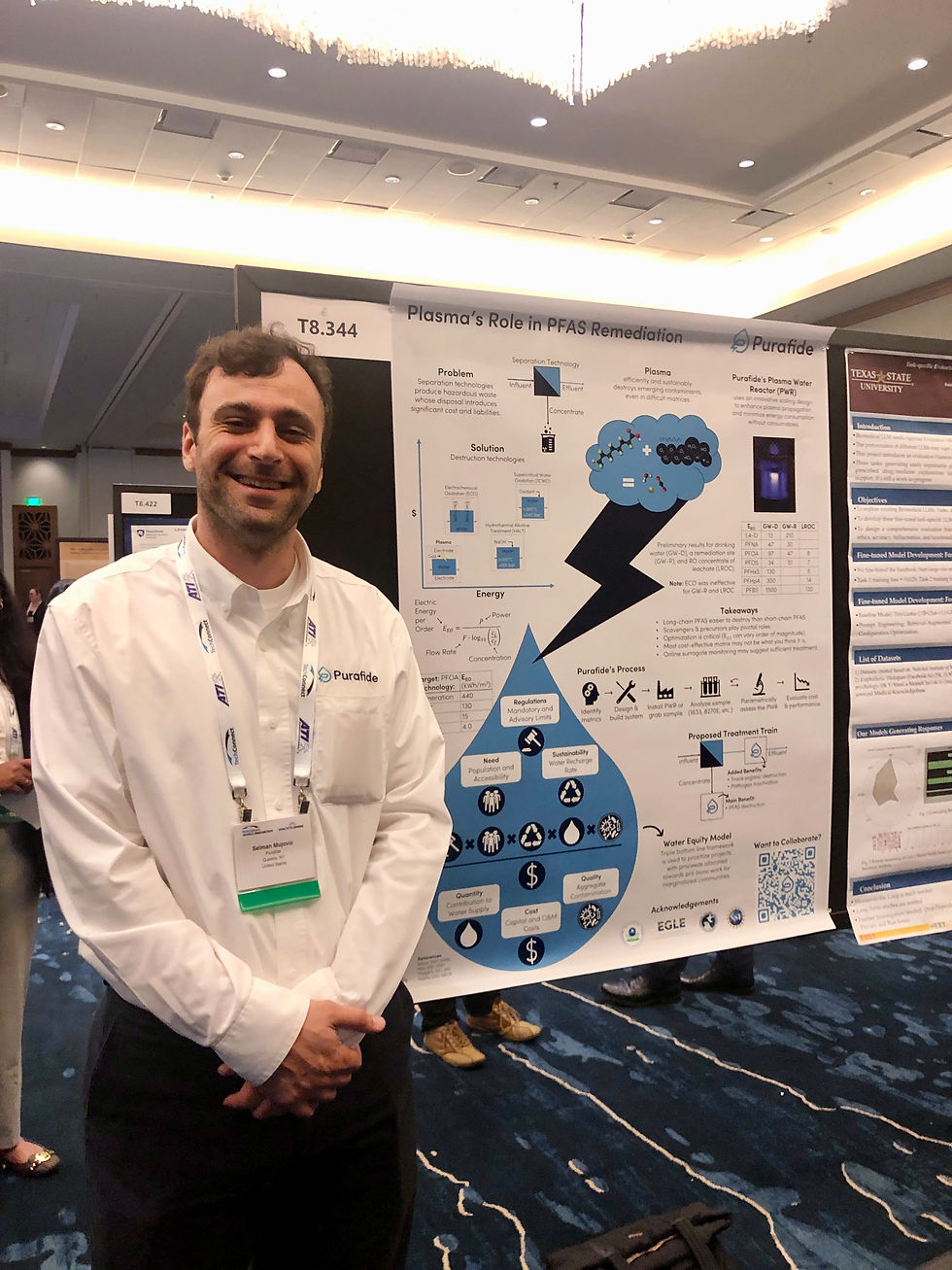
Purafide was also one of several companies to participate in the second annual NYC Innovation Hot Spot and NY I-Corps Hub-sponsored Discovery Bootcamp for I-Corps graduates in advance of the June 2025 TechConnect World Innovation conference. “The bootcamp helped us to make the most of the networking opportunity of TechConnect,” said Mujovic. “We made some great contacts there.”
Mujovic loves New York City and can boast longtime ties and a strong community in the network he has built around Purafide. He met his first hire, Luis Arias, now chief technician, at middle school. He’s known Jenelle Gustave, chief chemist, for more than a dozen years—he met her through her husband Christian. He, Luis, Christian, and Jensen Bouzi, who serves as a consultant, all attended a Saturday STEM program at New York’s American Museum of Natural History and Columbia University, which they attended from middle school through high school. Chief Data Scientist Vladimir Khin is a friend of nearly 20 years, since their days at Bronx Science. Other longtime friends, acquaintances, and family members have advised on HR, taxes, and accounting.
“I'm lucky to know people who are not only genuinely good and trustworthy people but also experts in their respective fields,” said Mujovic. “It's a win-win. I’ve also been so fortunate to have support from April Richards, former Environmental Protection Agency SBIR project manager; Rajesh Mehta, National Science Foundation SBIR project manager; and Nick Procopio, NJ Department of Environmental Protection research director—without them, none of this would be possible.”
“I am truly grateful that they helped a kid from Queens, who said in elementary school that he wanted to be a scientist, to live out his dreams,” he added. “I don't think my family, who were poor farmers in the mountains of Montenegro, would've thought that within a generation, one of their own would be protecting our natural resources from a state-of-the-art lab in the capital of the world.”


Comments